Factors to Consider When Choosing a Dry Fertilizer Spreader
If you’ve visited a farm show in the last decade or so, you probably saw a lot of new fertilizer spreading equipment.
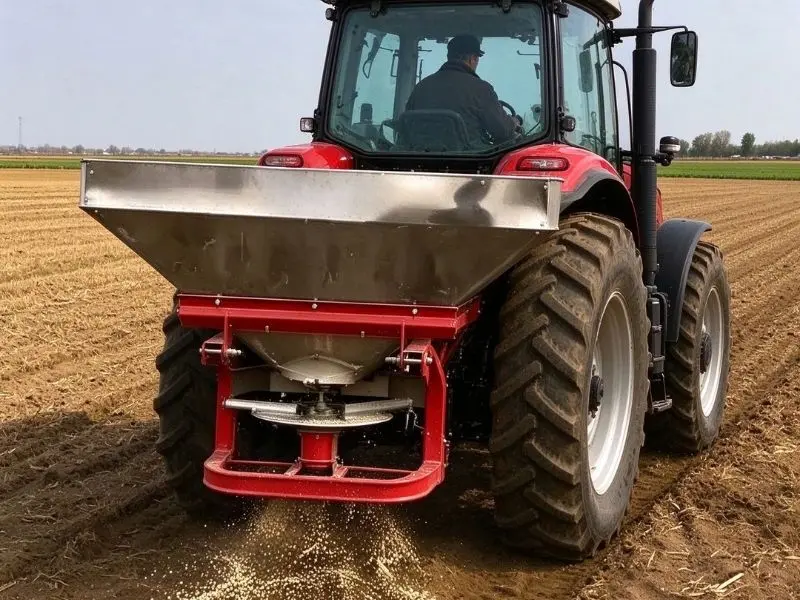
The new dry fertilizer spreaders have more features than the spinner carts your father or grandfather used. They still deliver high-quality, even distribution of dry fertilizer.
There are many factors to consider when deciding what size and type of dry fertilizer spreader fits your farming operation.
Dry vs Liquid Fertilizer Applicators
Liquid and dry fertilizer applicators are two of the most important pieces of equipment for nutrient management.
Both play an essential role in crop production, yet each works better in different scenarios and environmental conditions.
Liquid fertilizers are ideal when crops need quick nutrient uptake. Dry fertilizers support slow nutrient release to feed crops over longer periods.
Your choice between liquid and dry fertilizer also depends on your farm’s specific needs and local weather patterns.
Cost is another major factor. Always balance costs with your farm’s economic and sustainability goals.
Most growers can pick dry or liquid fertilizer applicators based on their unique operation needs.
Whichever applicator you choose, knowing how it works and its key features helps guarantee successful fertilizer application.
How Environmental Conditions Affect Spreader Performance
One critical point is understanding how your fertilizer spreader performs under changing field conditions throughout the year.
Wind speed and direction changes can reduce the uniformity of material distribution.
You may need to adjust driving direction or spinner speed to maintain proper fertilizer spreading.
Understanding factors that affect distribution helps you avoid common problems such as uneven spreading and fertilizer segregation.
A practical test method is placing catch pans on the ground and running the spreader over them during the growing season.
This test helps you check the spread pattern, and verify if it matches your prescription map and target application rates.
Adjust Spreader Settings for Different Fertilizer Products
You must adjust spreader distribution settings when switching fertilizer products. This matters especially if your prescription map includes multiple application rates.
Many operators overlook that settings need updates when the density of fertilizer or blended mixes changes.
Product density directly affects your ability to hit and maintain target rates in each field.
We recommend recording all spreader settings and product density variations year-round.
With these records, you can make timely adjustments and keep your machine working at peak performance all the time.